Most AI systems don't fail at capability.
They fail at behavior.
Outputs drift.
Authority boundaries collapse.
Memory contaminates unrelated tasks.
No one can reconstruct why behavior changed.
These failures compound under scale.
This is not a model failure.
It is an execution failure.
OIS enforces behavioral consistency under real-world conditions.
Failure Reality
What Actually Breaks
Most AI failures are not intelligence failures.
They are enforcement failures.
Memory Drift
Context leaks across tasks.
Temporary reasoning becomes permanent state.
Systems slowly contradict themselves.
Role Leakage
Agents exceed intended authority.
Permissions become ambiguous.
Operational boundaries decay over time.
Audit Collapse
Outputs cannot be reconstructed.
Decisions lose provenance.
No deterministic explanation exists after failure.
These failures compound under scale.
Most systems become untrustworthy long before models become incapable.
Runtime Enforcement
How OIS Governs Execution
OIS separates reasoning from authority.
The model performs cognition.
The runtime enforces continuity, boundaries, and validation.
State Injection
Rules and active state are injected for each request.
NO IMPLIED MEMORYContext Bounding
Only relevant context is exposed.
CONTROLLED CONTEXTCapability Enforcement
Roles and actions are constrained at runtime.
BOUNDARY ENFORCEMENTLLM Reasoning
The model reasons inside enforced boundaries.
INTERCHANGEABLE COGNITIONValidation Layer
Outputs are checked before persistence.
DETERMINISTIC VALIDATIONImmutable History
Actions and decisions are recorded append only.
TRACEABLE EXECUTIONOIS does not rely on prompts to preserve behavior.
Behavior is enforced structurally at runtime.
Architectural Difference
Why Existing AI Stacks Drift
Most AI systems coordinate reasoning.
OIS governs execution.
Behavior
Traditional
Prompt enforced
OIS
Runtime enforced
Memory
Traditional
Shared conversation
OIS
Structured layers
Capabilities
Traditional
Dynamic tool access
OIS
Explicit boundaries
State
Traditional
Mutable
OIS
Append only history
Focus
Traditional
Coordination
OIS
Governance
Dependency
Traditional
Prompt quality
OIS
Structural constraints
Context
Traditional
Cross context leakage
OIS
Bounded execution
Traditional AI Stacks
Coordinate reasoning
OIS Runtime Architecture
Govern execution
OIS was designed to preserve operational continuity under scale.
Not just generate intelligent outputs.
OIS is already running in production.
Real systems. Real usage.
Behavior that holds when it matters.
1M+ System Executions
Tested under operational and evolving conditions.
Same input → same output
Across repeated executions.
Zero Drift
Behavior remains consistent over time.
100% Traceable
Every output. Every step.
TrustStarterKit
Deterministic legal document system

Guided trust creation. Attorney-drafted.
State-specific. Proven reliable.
Continuum
Structured reasoning system
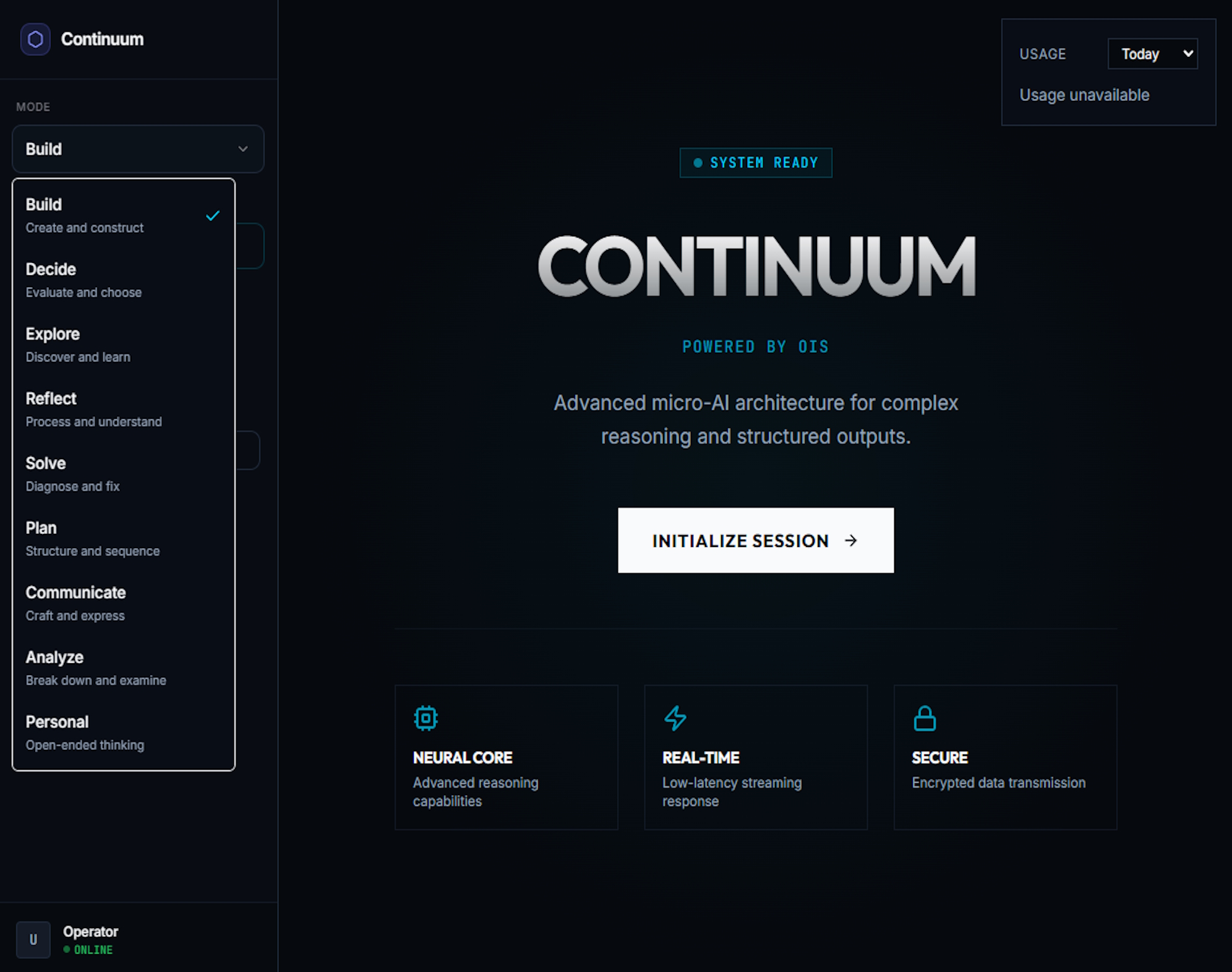
Micro-AI architecture for complex reasoning
and structured outputs.
What this runtime guarantees
Built for behavior that holds.
The system enforces consistency, context, and control at every step of execution.
This is not how standard
AI systems behave.
The same input produces the same output
Deterministic results across runs, every time.
Context does not get lost between steps
Persistent memory maintains continuity across the entire flow.
The system always knows exactly what state it's in
Current state is tracked and maintained in real time.
Every output can be traced back to its source
Full traceability from request to response.
The system enforces correct behavior regardless of how the prompt is written
Constraints are built in, injected, and enforced.
Evaluate OIS
Request Evaluation Access
Run OIS against your own system and evaluate behavior, consistency, and continuity under real conditions.
- Run your workflows
- See behavioral consistency
- Compare outputs
- Audit every step